

Grecian facial features refer to a set of classical aesthetic proportions derived from ancient Greek art, defined primarily by a straight nasal bridge that forms an uninterrupted line from the forehead down to the tip of the nose. This profile relies heavily on mathematical symmetry, precise facial thirds, and a defined jawline. While originally an artistic ideal sculpted into marble statues, the Grecian profile remains one of the most recognized benchmarks in facial aesthetics and modern anthropometry.
Understanding these historic canons helps clarify how global aesthetic values evolved over time. If you want to evaluate how closely your own structure aligns with classical geometry, the Glow Up & Attractiveness Test uses fine-tuned AI to provide a personalized face rating score and detailed facial analysis from a single selfie. Cross-referencing your profile against historical standards offers fascinating context into how beauty definitions fluctuate across different standards of beauty around the world.
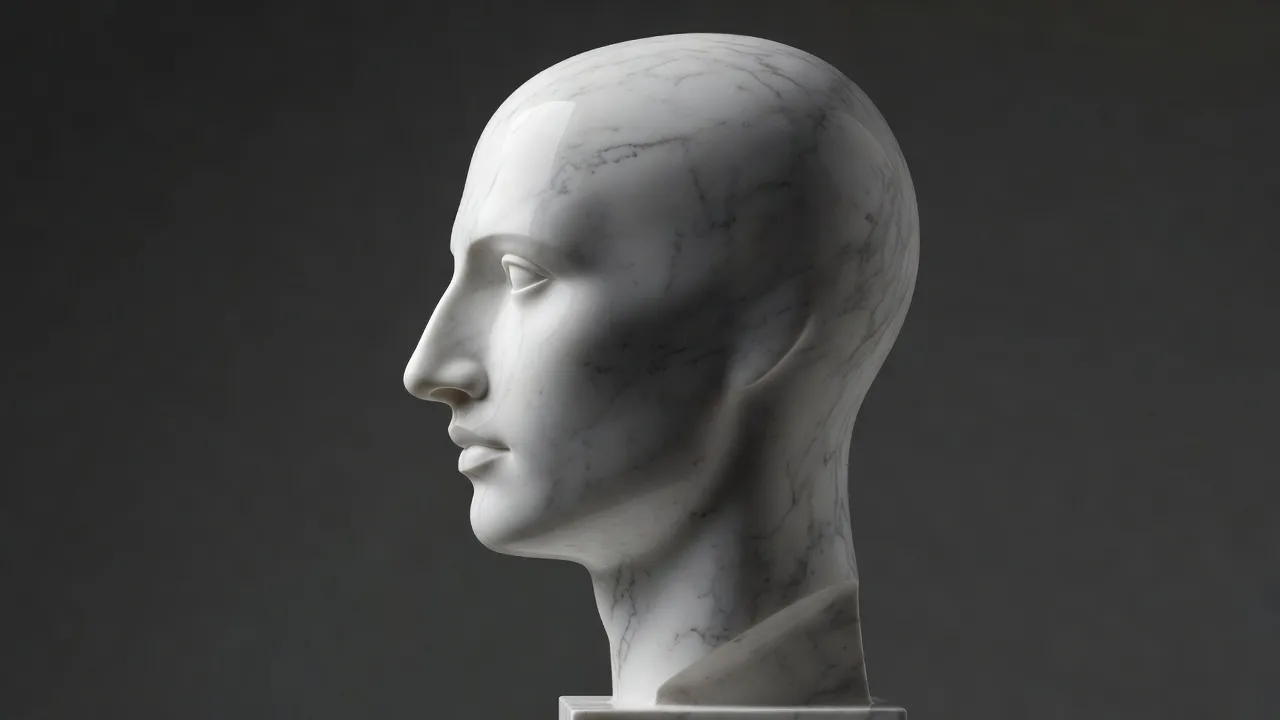
What is the 'Grecian nose' or 'Grecian profile', and what is its history?
The Grecian nose, or Grecian profile, is a nasal conformation where the bridge is perfectly straight with little to no dip at the radix, creating an unbroken slope from the brow bone to the tip. In classical antiquity, Greek sculptors created this profile to depict gods and idealized heroes rather than ordinary citizens.
Ancient Greek artists in the 5th century BCE sought to capture divine perfection through geometry rather than portrait realism. They purposefully minimized the nasal indentation between the eyes (known anatomically as the nasion). This created a continuous plane between the forehead and the bridge of the nose.
Historical analysis reveals that this specific silhouette was rarely found in the natural population of ancient Greece. Instead, it served as a visual marker of nobility, calm emotional control, and spiritual elevation in statues. Over centuries, literary descriptions popularized the term "Grecian profile" to describe anyone with a straight, high-bridged nose and symmetrical facial balance.
What are the origins of the 'Grecian profile' in Renaissance art history?
The origins of the Grecian profile in Renaissance art history stem from 15th-century Italian scholars rediscovering classical Greco-Roman sculptures and formalizing their facial proportions into mathematical art manuals. Renaissance masters viewed classical Greek art as the pinnacle of aesthetic harmony and systematically copied classical busts to establish standardized drawing canons.
During the High Renaissance, figures like Leonardo da Vinci and Leon Battista Alberti studied surviving Roman copies of Greek statues. According to architectural and artistic records documented by the Metropolitan Museum of Art, Renaissance theorists translated these ancient marble shapes into strict mathematical grids.
Artists used the Grecian nose to convey moral purity and intellect in religious and historical paintings. By eliminating facial irregularities, bumps, or curved profiles, painters created portraits that felt timeless. This Renaissance revival cemented the straight Greek profile as the primary standard of classical Western art for centuries to follow.
How does a 'straight nose' differ from an 'aquiline nose' in the Grecian profile?
A straight nose features a flat, uniform bridge that descends cleanly from the forehead, whereas an aquiline nose has a prominent convex curve or hump that resembles the curved beak of an eagle. While both profiles are associated with classical European sculpture, they originate from distinct historical and anatomical traditions.
The primary difference lies in the nasal dorsum. The Grecian nose keeps a linear 180-degree path along the bridge. In contrast, the aquiline nose (often called a Roman nose) arches outward before sloping down toward the tip. You can explore more about how dorsal humps and slope angles alter your face side profile in modern aesthetic evaluations.
As detailed in anatomical descriptions on Wikipedia's guide to the aquiline nose, the convex structure of the aquiline nose was historically favored by Roman sculptors to symbolize power and authority, whereas Greek sculptors preferred the straight nose to emphasize balance and divine stillness.
| Profile Attribute | Grecian Profile (Greek Nose) | Aquiline Profile (Roman Nose) | Celestial Profile (Button Nose) |
|---|---|---|---|
| Nasal Bridge Shape | Straight and continuous | Convex arch or dorsal hump | Concave dip with upturned tip |
| Radix Depth | Extremely shallow or flush | Deep to moderate dip | Pronounced dip below brow |
| Nasal Tip Angle | Neutral (90-95 degrees) | Slightly drooping or hooked | Upturned (>100 degrees) |
| Historical Symbolism | Divine harmony, symmetry | Power, command, leadership | Youthfulness, delicacy |
| Dominant Era | Classical Greece (5th C. BCE) | Imperial Rome & 19th C. Europe | Mid-20th Century to Present |
What is the classical Greek canon of facial proportions seen in Polyclitus's Doryphoros?
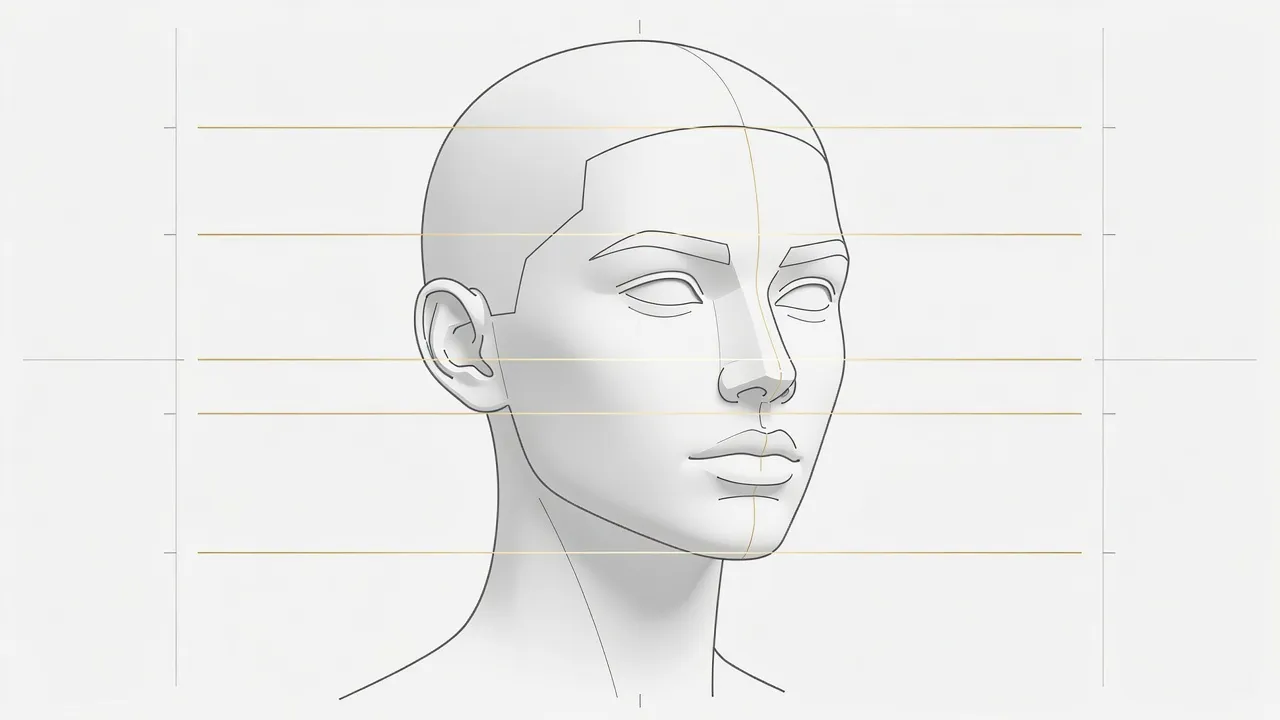
The classical Greek canon of facial proportions seen in Polyclitus's Doryphoros divides the face into three equal horizontal segments and sets the total head height at exactly one-eighth of overall body height. Created in the 5th century BCE, this sculptor's treatise established a strict mathematical system based on ratio and balance.
Polykleitos (often spelled Polyclitus) designed the Doryphoros (Spear-Bearer) statue to demonstrate his written treatise, known as the Canon. As noted in historical entries on Wikipedia's page for Polykleitos, his mathematical system relied on the principle of symmetria, where every small component relates proportionally to the entire body.
The facial division of the Polyclitan canon breaks down into three distinct, equal zones:
- Upper Third: From the hairline (or top of the forehead) down to the line of the eyebrows.
- Middle Third: From the brow line down to the base of the nose (subnasale).
- Lower Third: From the base of the nose down to the bottom of the chin.
If these three segments measure identical heights, the face meets the classical standard of horizontal harmony. Additionally, Polyclitus mandated that the width of the nose should equal the width of one eye, establishing an early version of vertical facial fifths.
What are the facial characteristics of Greek kouros statues from the Classical period?
Facial characteristics of Greek kouros statues feature rigid bilateral symmetry, stylized almond-shaped eyes, a broad flat forehead, a straight prominent nose, and a faint, expressionless smile known as the archaic smile. These life-sized marble statues of young men represent the transition from archaic Egyptian influence to early classical realism.
According to historical records on Britannica's guide to kouros figures, early archaic sculptors carved these figures using rigid grid blocks. This technique produced facial features that were geometric rather than individually expressive.
Key facial traits observed across surviving kouros figures include:
- Almond-Shaped Eyes: Eyes were carved large and flat, set shallowly under high arching brows without deep eyelid folds.
- The Archaic Smile: Lips were slightly curved upward at the corners despite flat cheek muscles, giving the impression of transcendent calm.
- Geometric Ear Placement: Ears were carved as stylized spirals, often set slightly higher or further back than natural anatomy dictates.
- Integrated Nasal Line: The nose emerged directly from the forehead plane without a deep indentation between the eyes.
As Greek sculpture evolved from the Archaic to the High Classical period, these stylized traits relaxed into naturalistic musculature while preserving the straight Grecian profile.
How do Grecian facial features influence modern facial analysis?
Modern facial analysis relies heavily on classical Grecian principles, using horizontal thirds, vertical fifths, and nasal bridge angles to measure facial harmony in clinical and aesthetic settings. Plastic surgeons, orthodontists, and digital algorithms still use these ancient geometric ratios as baseline benchmarks.
In contemporary cosmetic medicine, practitioners evaluate the nasofrontal angle (where the forehead meets the nose). A classic Grecian profile has a wide nasofrontal angle approaching 130 to 140 degrees. As of September 2026, non-surgical rhinoplasty procedures using dermal fillers frequently aim to soften sharp nasal humps to recreate this smooth, straight bridge contour.
For those curious about their own facial proportions, the Glow Up & Attractiveness Test app on iOS offers automated feature detection. The app analyzes your selfie to measure symmetry, compute your beauty score, and outline personalized tips based on structural aesthetics. You can perform a full analysis of face geometry without needing complex manual measurements.
Can facial exercises or styling highlight a Grecian profile?
While skeletal bone shape cannot be shifted without surgery, strategic hair styling, targeted contouring makeup, and proper neck posture can highlight your central facial features and clean up your side profile. Makeup techniques in particular can simulate the continuous bridge characteristic of the classical look.
To create the illusion of a straighter, more defined profile using styling methods, consider these approaches:
- Nasal Contouring: Apply a light concealer down the exact center line of the nasal bridge. Blend cool-toned contour shadow down both sides in parallel lines from the inner brows to the tip to draw attention to vertical straightness.
- Haircut Direction: Hairstyles that pull hair slightly away from the forehead and temples emphasize the line connecting your brow bone to your nose. Avoid heavy forward bangs if you want to showcase your side profile.
- Posture Alignment: Keeping your head aligned over your shoulders prevents soft tissue from obscuring your jawline. Good posture maximizes the visual distance between your chin line and neck.
Exploring realistic cosmetic approaches helps maintain balanced expectations. While styling alters visual perception, embracing your unique structural traits is usually far more satisfying than trying to match a 2,500-year-old marble statue.

Frequently Asked Questions
What does a true Grecian profile look like?
A true Grecian profile features a straight nose bridge that forms a nearly continuous line down from the forehead without a dip between the eyes or a hump along the bone. The face exhibits balanced horizontal thirds and a firm jawline.
Are Grecian facial features rare in real life?
Yes, a naturally straight Grecian profile with zero nasal radix dip is anatomically rare. Classical Greek sculptors created this feature as an artistic ideal of divine perfection rather than an accurate portrait of average humans.
What is the difference between a Grecian nose and a Roman nose?
A Grecian nose is completely straight from top to tip. A Roman nose (aquiline nose) features a distinct outward curve or hump along the upper bridge, giving it a hooked silhouette.
Why did Greek statues all have the same facial features?
Greek sculptors followed mathematical mathematical rules called canons, such as the Canon of Polyclitus. These rules prioritized ideal proportions, symmetry, and divine harmony over individual portrait variations.
Can non-surgical procedures create a Grecian profile?
As of 2026, non-surgical rhinoplasty using liquid dermal fillers can temporarily fill the dip at the nasal radix, creating the visual appearance of a straight Grecian bridge without permanent surgery.
Is the Grecian profile considered the universal standard of beauty?
No, facial beauty standards vary significantly across different cultures and eras. While the Grecian profile shaped Western classical art, many global aesthetics value different nose shapes, cheekbone structures, and profile angles.
How do I measure my facial thirds at home?
Measure the distance from your hairline to your brow line, from your brow line to the base of your nose, and from the base of your nose to the bottom of your chin. Equal distances across all three segments indicate classical facial third balance.