
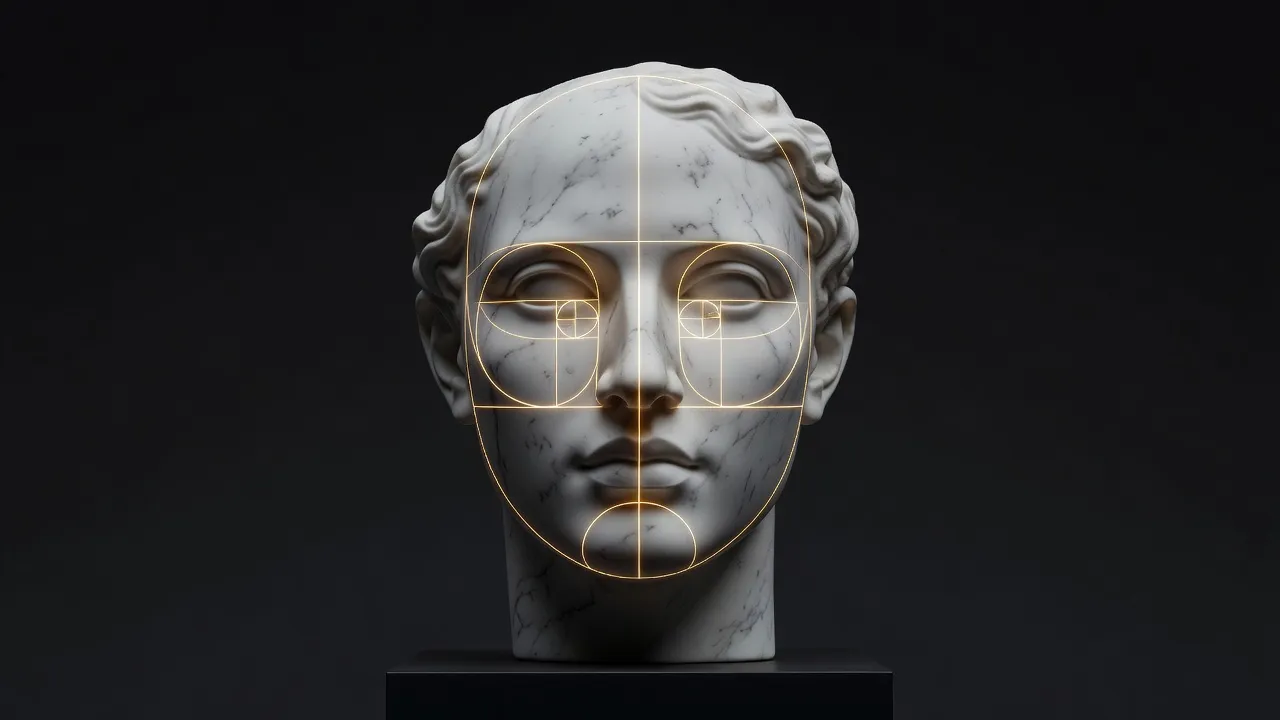
Divine beauty is an aesthetic and philosophical concept that evaluates physical attractiveness through mathematical proportions, facial symmetry, and timeless structural balance. Rooted in the classical Greek ideal of kalokagathia, it separates fleeting fashion trends from universal geometric principles like the Golden Ratio (1:1.618). Understanding these structural anchors helps clarify why certain facial layouts evoke instant aesthetic harmony across different cultures.
People often confuse divine beauty with temporary trends, but the core framework relies on objective proportions found throughout nature. As of September 2026, facial aesthetic researchers continue to measure how mathematical ratios influence subconscious visual attraction.
What is the mathematical foundation of divine beauty?
The mathematical foundation of divine beauty relies primarily on the Golden Ratio, also known as Phi ($\phi$), which equals approximately 1:1.618. This geometric ratio appears repeatedly in natural structures, from seashell spirals to human bone proportions. When applied to the face, the ratio measures distance relationships between key features like the eyes, nose, lips, and jawline.
Classical artists and sculptors used these measurements to map out ideal facial layouts. According to historical records on the Wikipedia Golden Ratio page, Renaissance masters like Leonardo da Vinci calculated facial proportions using precise geometric subdividers.

How does the Golden Ratio measure facial harmony?
To measure facial harmony using Phi, facial analysts calculate the ratio of total face length to total face width. An ideal divine face structure measures roughly 1.618 times longer than it is wide.
Analysts also measure specific sub-intervals across the center of the face:
- The distance from the top of the nose to the center of the lips compared to the length of the lips.
- The width of the mouth relative to the width of the nose at its base.
- The vertical distance from the hairline to the eyebrow versus eyebrow to nose base.
When these individual facial segments mirror the 1.618 ratio, the visual presentation registers as balanced and effortless to the human eye.
Is perfect facial symmetry mandatory for divine beauty?
No, complete mathematical facial symmetry is not mandatory for divine beauty, though high bilateral symmetry increases perceived attractiveness. Studies indexed on the National Center for Biotechnology Information demonstrate that perfectly mirrored faces often look uncanny or unnatural to human observers.
Subtle micro-asymmetries give human faces emotion, character, and life. Divine beauty requires high structural alignment rather than a rigid, computer-mirrored clone effect.
How has the perception of divine beauty evolved across history?
Historical perceptions of divine beauty shifted from strict physical geometry in antiquity to spiritual character during the Middle Ages, returning to structural science during the Renaissance. Ancient Greeks viewed physical harmony as direct evidence of internal virtue and divine favor.
The entry on aesthetic history in the Stanford Encyclopedia of Philosophy notes that classical scholars treated proportion (symmetria) as an objective fact rather than a personal opinion. Over time, regional preferences modified these ideals, creating distinct cultural variations across different eras.
While foundational geometry remains steady, regional preferences influence modern standards. You can read more about how global perspectives differ in our guide on standards of beauty around the world.
What are the limits of relying solely on mathematical beauty?
The primary limit of mathematical beauty is that static geometric formulas ignore skin health, facial expressions, eye contact, and individual movement. A face can possess mathematically ideal ratios on paper yet appear flat or uninviting in motion.
Relying entirely on bone measurements overlooks critical attributes that affect real-world attractiveness:
- Skin tone uniformity and texture clarity.
- Dynamic facial muscle expression during laughter or conversation.
- Eye vitality and contrast between the iris and sclera.
- Overall grooming and hair frame balance.
| Divine Aesthetic Category | Mathematical Ideal (Neoclassical Canon) | Biological & Dynamic Signal | Practical Limitation |
|---|---|---|---|
| Facial Vertical Division | Equal thirds (Hairline to brow, brow to nose, nose to chin) | Soft tissue fullness & lip volume | Ignores aging skin laxity over time |
| Facial Horizontal Division | Equal fifths (Five eye-widths across the cheekbones) | Interpupillary distance alignment | Does not account for cheekbone projection depth |
| Bilateral Symmetry | 100% mirrored left and right facial landmarks | Minor natural asymmetry | Exact 1:1 mirroring creates an uncanny appearance |
| Profile Projection | 30-degree facial convexity angle | Jawline definition and posture | Static profiles ignore natural neck movement |
For most people, calculating these complex measurements by hand using calipers is tedious and impractical. If you want a fast, automated breakdown of your proportions, I recommend using the Glow Up & Attractiveness Test. The app provides a detailed face analysis using a fine-tuned AI model to evaluate your facial landmarks instantly.

Can modern technology objectively analyze facial proportions?
Yes, modern computer vision algorithms can objectively map hundreds of facial points to calculate structural ratios in seconds. Neural networks compare your photo against datasets of facial geometry to measure jawline symmetry, eye alignment, and midface proportions.
Instead of guessing where your features sit on the classical scale, mobile software automates the math. Using the Glow Up & Attractiveness Test iOS app, you can snap a selfie to discover your beauty score and get tailored tips to beautify your look based on your unique geometry.
These tools take the guesswork out of facial analysis. They highlight your best proportions while giving you a clear glow up guide to improve framing and skin presentation.
- Classical Golden Ratio (1:1.618)
- Facial Landmark Coordinate Mapping
- AI Neural Network Proportions Check
- Actionable Grooming & Symmetry Guidance
Each step feeds into the next in the order listed.
How does divine beauty differ from amazing beauty in modern culture?
Divine beauty refers to timeless, objective facial proportions, whereas amazing beauty often describes striking individual style, high charisma, or dramatic styling. While divine aesthetics depend on classical bone ratios, amazing beauty can stem from vivid eye color, unique facial features, or confident self-presentation.
Understanding the difference prevents people from assuming there is only one way to look attractive:
- Divine Beauty: Focused on bone structure, golden ratio proportions, and balanced facial thirds.
- Amazing Beauty: Focused on high contrast, memorable facial expressions, unique features, and magnetic presence.
It helps to remember that while geometry plays a role, beauty is subjective when evaluated through personal emotional connection. A face that falls slightly outside classical mathematical rules can still hold incredible visual power.
How do you improve your facial harmony based on divine proportions?
You can improve perceived facial harmony by using targeted grooming, hair styling, and posture habits to balance your natural proportions. While surgical modification alters underlying bone, non-invasive adjustments shift visual weight to bring features closer to classical balance.
Here are four simple ways to optimize your facial balance:
- Frame your face shape with hair: Adjust your hair volume to balance out an elongated midface or a narrow jaw.
- Shape your eyebrows intentionally: Extend or arch your brows to adjust the visual distance of your upper facial third.
- Optimize your neck and tongue posture: Keep proper oral posture to sharpen jawline definition and improve your side profile.
- Maintain skin clarity and hydration: Smooth skin texture increases visual contrast, emphasizing your underlying facial structure.
If you are curious where your current features rank, checking your digital beauty score offers a helpful starting baseline. Tracking your proportions over time shows how small styling tweaks shift your overall visual presentation.
Ultimately, divine beauty serves as an objective reference map rather than a rigid rulebook. Combining classical structural balance with modern skincare and styling allows anyone to present their most harmonious self.
Frequently Asked Questions
What is divine beauty?
Divine beauty is an aesthetic concept that defines facial attractiveness through mathematical proportions, golden ratios, and balanced structural symmetry.
What is the Golden Ratio for facial beauty?
The Golden Ratio for facial beauty is approximately 1:1.618, representing the ideal proportional relationship between facial height, width, and feature placement.
Is divine beauty entirely universal across cultures?
While core preferences for facial symmetry and smooth skin are universal, specific preferences for feature size and cheek volume vary by region.
How is divine beauty measured today?
Modern computer vision software maps facial landmark coordinates from a photo to calculate proportional distances and symmetry ratios automatically.
Can you have divine beauty without perfect symmetry?
Yes, minor natural micro-asymmetries prevent a face from looking synthetic while maintaining strong overall structural alignment.
What is the difference between divine beauty and amazing beauty?
Divine beauty relies on strict mathematical bone geometry, whereas amazing beauty often stems from striking contrast, styling, charisma, and distinct features.
How do facial thirds relate to divine beauty?
Classical divine beauty divides the face into three equal horizontal segments: hairline to brow, brow to nose base, and nose base to chin bottom.